
Nature as Mirror
The reflection that alters us the closer we look
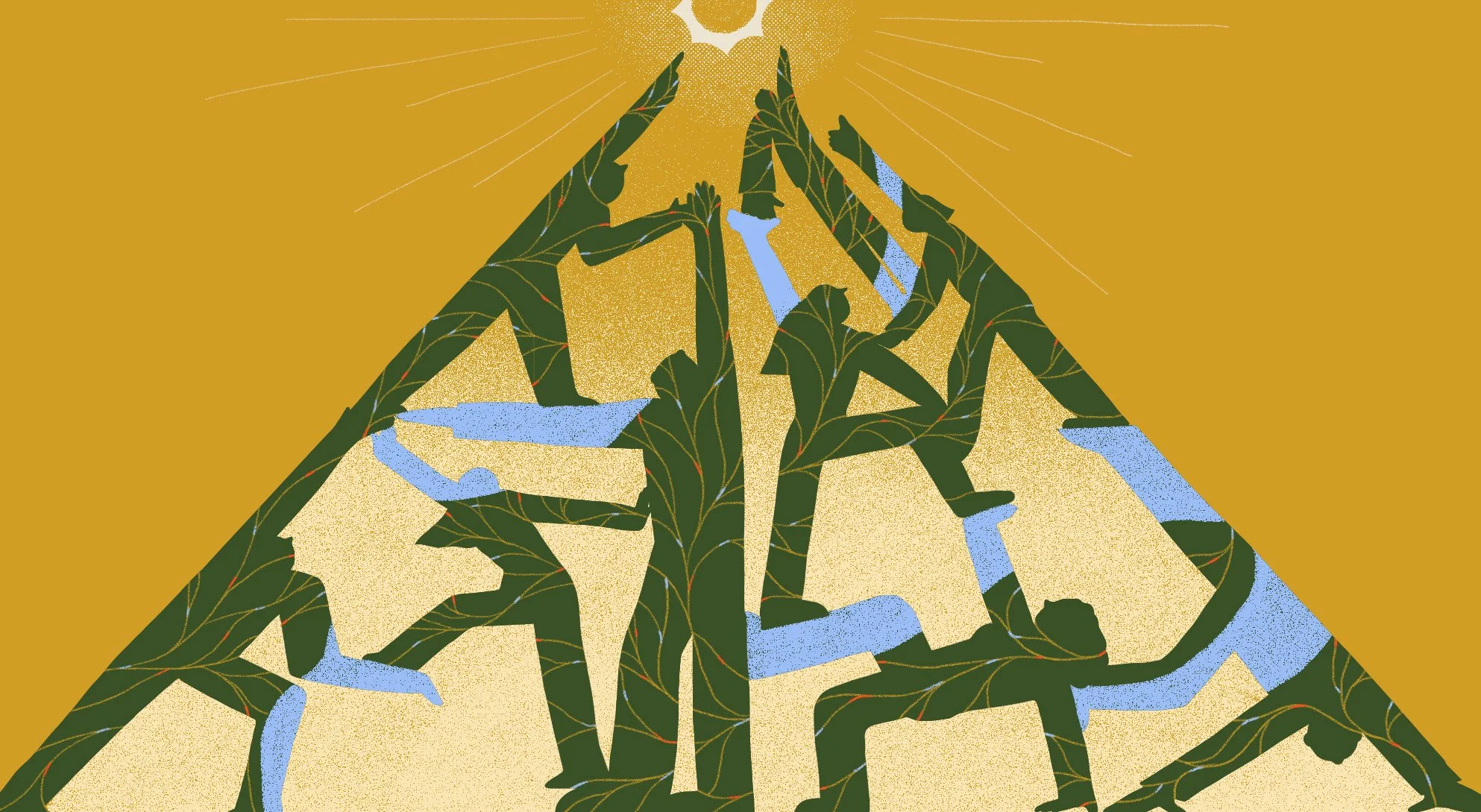
Image: Gina Rosas Moncada
“The major problems in the world… are the result of the difference between how nature works and the way people think.” Gregory Bateson
I recently found myself standing next to a pack of African wild dogs at feeding time with a group of executives. An unusual setting for a leadership programme, but a fruitful one. Alpha, top dog, competitive landscape, queen bee, hive mind, business ecosystem – at the root of many of our mental models of leadership, how we organise and how we relate to one another, we often find metaphors rooted in nature. In this quarterly I’ll share some examples that have proved usefully provocative for curious, reflective leaders in our programmes. A walk in nature can help us to resolve a complex problem, but deeper attention to what is evolving around us can open double or triple loops of learning: questioning whether we have the right frame or goal, and questioning the fundamental beliefs or assumptions that led us that frame or goal.
In this brief safari I invite you to observe not only nature, but yourself – your responses to it, and your underlying assumptions. The nature metaphors we’ll explore exist between us, and between us and the rest of the living world: formed by the values and mental models we project onto the constantly evolving, infinitely rich and mysterious living world in the search for patterns of meaning. Consequently, they are limited and coloured by the dominant values at the time of their creation. This isn’t a linear process: our mental models limit what we see in nature, while fresh metaphors reveal to us things that were always there, and receptive observers of nature find novel metaphors, which open new possibilities that do not fit our existing mental models of the world.
First a quick recap of how metaphors shape our shared reality. Lakoff and Johnson argued in their classic ‘Metaphors We Live By’ that metaphors are pervasive not just in our language, but in our thought and action. Argument as war is a metaphor we live by: ‘your claims are indefensible’, ‘criticisms were right on target’, ‘she shot down all of his arguments’. We talk about arguments as war because we conceive of them as war. Not, for example as a dance, or a flow, or as a sculpture in the making, each cut revealing something new. This is especially true of our mental models about organisations. We often talk about organisations as if they were machines, and as a consequence we expect them to behave like machines, reliably, efficiently and predictably performing their functions. Machine learning and particularly the ubiquity of Large Language Models may now give rise to a new version of this mechanistic thinking, with unfortunate consequences..
Digging up the roots of strategy
We routinely talk about business environments, business ecosystems and ecosystem strategies to understand the dynamics of collaboration and competition between different actors serving a common customer. Running through all such concepts and all business strategy is the metaphor of competitive exclusion – first referenced by Bruce Henderson in his Origin of Strategy. This metaphor lifts the image of non-human species competing for advantage in a territory – an ecological niche – and the role of natural selection and applies it to business planning. Competitors cannot co-exist, therefore they must differentiate, and had better do so consciously, in a kind of intentional evolution called strategy. The objective is competing for territory by increasing the scope of your advantage, which ‘can only happen at someone else’s expense’. This is congruent with another dominant inspiration and source of metaphors for strategy, military planning. The metaphor is very dominant: commercial strategy more or less is choosing where and how to compete for territory in my language, in the same way that argument is war. But we are capable of adding other metaphors to our repertoire. After all, owners and leaders of corporations thought about business planning with very different metaphors in the past. If you doubt it, look at pre-1960s Quaker-founded companies like Rowntree and Cadbury’s for a strong contrast.
Is competition for dominance what drives the diversity we see in life?
As far back as 1993 strategist James F Moore used ecological metaphors to explain how companies from different industries co-evolve around a new innovation – eg, the personal computer, the smartphone – collaborating to serve and build customer demand. The result is different business ecosystems competing for dominance, still a helpful concept for explaining Microsoft’s Azure and Amazon’s AWS cloud computing behaviours. At the time of writing, imagining drivers of success other than competition for territory and power is hard: might-makes-right nationalism and intense competition between tech platforms for dominance is absorbing so much attention and capital. Tech firm leaders seem to be driven by an ‘arms-race’ for AI competitive exclusion between themselves, playing out against competition between superpowers. Competitive races can lead to breakthroughs in technology and collective achievement – take the space race for example – but successful exclusion of all competition doesn’t result in a healthy ecosystem for everyone else. Arguably in the case of tech platform businesses, consumers and citizens benefit initially but ultimately see the quality of service erode: what Cory Doctorow has diagnosed as ‘enshittification’: “First, platforms are good to their users; then they abuse their users to make things better for their business customers; finally, they abuse those business customers to claw back all the value for themselves. Then, they die.” We might not like the outcomes, but competition for resources and exclusion of other species are very useful metaphors for understanding our world, and both are observable in nature. Are there just different scales over which competition plays out in nature – individual, group, ecosystem - or are there other forces at work?
In nature success in accessing resources and defending against attack is often determined by the actions of a group or assemblage of different species. Groups of animals like orcas, chimps and New Caledonian crows learn innovative behaviours from one another, creating cultures that are passed on through generations. Groups with different cultures are a source of variation for selection to act upon at the group level. Groups that can sustain effective cooperation can outcompete groups whose members cannot cohere – as David Sloan Wilson concisely summarised: “selfishness beaths altruism within groups. Altruistic groups beat selfish groups. Everything else is commentary”. Assemblages of animals can effectively collaborate: different species of birds and some mammals understand each other’s warning calls, and flock together for safety, and many species collaborate to find food, and police these partnerships for fairness. Collaboration between species and creation and transmission of information within groups can both be sources of competitive advantage and success.
Trees of the same species and different species form a network of information and nutrient exchange mediated by different fungi - the ‘wood wide web’ discovered first in the 1990s by Professor Suzanne Simard. Interfaces between plant roots and fungi, or mycorrhiza (‘fungus-root’), are linked together by the remarkable thread-like network bodies of fungi, the mycelium. Mycorrhizal networks and the mycelium itself are both potent metaphors for how we relate to one another and our socioeconomic systems – especially for organisations concerned with social justice. Depending on our values and experience of the word, we may see in these associations dynamic systems of conflict, dependence and exploitation, or interspecies cooperation and mutual support for resilience. Or perhaps something that includes all these and more. Nature does not offer a simple story, and it’s impossible for us to read clear-eyed in any case. Like the rest of us, scientists are not immune to seeing only what the dominant mental models of society at that time permit.
Let’s return to that fundamental idea that organisations and organisms compete for territory through increasing the scope of their advantage at another’s expense. In healthy ecosystems we can all observe vast and increasing diversity of species over time – somewhere between 5-30 million species are alive today. Instead of winners-take-all, we have co-existence everywhere. To take just one ecosystem, there can be around 100 species of corals on a healthy tropical reef, and 150 species of fish feeding and sheltering on them. This diversity would surely not be maintained if species were continually moving in on one another’s turf and snuffing out the competition. Ecologists have sought to explain this seeming paradox in many ways. For example, if the landscape shifts, the rules of the game change constantly, and no one species can dominate for long. Maybe this isn’t really a competitive hierarchy, instead, like a multi-dimensional game of rock-paper-scissors, a winner in one competitive contest is a loser in a second contest with a third party, which the previous loser wins. Species are constantly ‘resource partitioning’ or dividing up the same finite resource into fine variations and specialising in one, or using the same resource but at different times, or in different spaces. All of these ecological theories have a version in commercial strategy – the market niche, the long-tail, for example. But competition alone doesn’t explain all the interactions we see in nature.
Co-existence of so many species is only a paradox if we take competitive exclusion as a fundamental truth. If we look only for competition in nature to explain success and the rich diversity of life, we are blinkering ourselves and missing the whole. For there are clearly not only negative interactions like competition, predation and parasitism, but also widespread beneficial interactions between species – like the mycorrhizal association between fungus and plant – that enable species to succeed, and drive specialisation, speciation and co-existence.[1] These are often hidden in plain sight because the assumption that it is difficult for species or organisations to co-exist has rooted deeply into both ecology and strategy, framing the primary questions and shaping thought for decades.[2] Multispecies communities with very high numbers of species living alongside one another are the norm, and single-species dominated ecosystems the exception – confined to extreme or disturbed environments like intensive agriculture. Ecologists are beginning to revisit the principle of competitive exclusion and explore the principle of coexistence. How might coexistence drive evolution and thus the success or failure of species?
Many plants facilitate the growth of other species’ seedlings through creating the right micro-climate, increasing access to nutrients, or protecting them from grazing. The humble bramble, our namesake, does just this for many tree species. But when these young plant ‘start-ups’ grow sufficiently large, they compete for resources with their original benefactor. So how can this facilitation dynamic persist? A recent study found that 90% of these acts of facilitation are indirectly reciprocated, i.e. the young plants of the benefactor species are themselves helped by other plant species, in a long chain of support eventually arriving back at the original beneficiary[3] (for a robust explanation see this presentation by one of the authors). What goes around, comes around, in interspecies plant interactions at least. This helps to explain something generally observed – life creates conditions conducive for life to thrive. Diversity of species and their ecological relationships is a key factor determining the resilience and health of the whole assemblage or community. And the diversification of species seems to be strongly influenced by the support given to other species, as well as competition with them.
Could there be such a thing as a competitive co-existence strategy?
A co-existence or ecosystem-wide strategy of supporting other organisations to reach maturity and then vigorously competing with them seems hard to imagine at a time of heightened geo-economic competition between power blocs, and a rapid cycle of value extraction and concentration in technology platforms. I have no prescription, I intend only to offer food for thought. Treating co-existence as a principle as fundamental as competition in nature offers a challenging mirror to us. What clues do we have as to what a ‘competitive coexistence’ strategy might look like?
An obvious parallel might be large companies supporting SME suppliers within their sphere of influence, for example offering preferential finance and accelerated payment rather than cash-flow stressing 60-day plus payment terms. Versions of this are common where pressures dictate, eg mining companies required to invest in local suppliers, large defence companies incentivised to incorporate innovative SMEs into their supply chains. But these are direct value exchanges, not the facilitation of a range of potential future competitors with only very indirect benefits.
Organisations restoring and working with natural ecological processes are familiar with competition and co-existence in a practical sense. Regenerative agriculture businesses utilising agroecological systems to increase biodiversity above and below ground alongside crops, for example shade-grown coffee, are actively managing competition and coexistence between wild and cultivated species.
Philanthropic organisations are sometimes deeply invested in ‘field-building’, supporting the infrastructure and relationships that resource and enhance a whole ecosystem of actors. Our non-profit Bramble.org is supporting Civic Power Fund, which has a strategy to not only directly fund grassroots groups, but build the infrastructure they need to thrive, and invest in the civic leaders who power them.
At the scale of an innovation ecosystem perhaps we can see the indirect, reciprocal facilitation of future competitors that is so striking in a healthy plant community. Victor Hwang and Greg Horowitt describe the complex social infrastructure of culture and social networks that has generated the Silicon Valley phenomenon by using the metaphor of a rainforest, comprised of millions of small interactions of facilitation, rapidly developing unconventional ideas, individuals and experiments. Like a tropical rainforest, innovation ecosystems such as Silicon Valley are incredibly good at creative reassembly – rapid cycles of endings, decomposition and recombination into new patterns.
Where are our metaphors for leadership are limiting us?
Nested within our mental models about competition and coexistence are our mental models of leadership. The way we talk about leaders unconsciously reinforces core metaphors: leader as captain (setting direction, charting a course, navigating difficult waters), engineer or architect (designing for scale, building resilient systems or organisational architecture), or perhaps coach / gardener (nurturing culture, growing talent, creating fertile ground). And less favoured in public organisations now, but still in use and alive in contested cultural environments, leader as hero, warrior, chief, alpha male or top dog. Do you recall using the language of alpha male or female to describe a kind of leader associated with assertiveness and dominance? This metaphor entered popular psychology in the 1980s via scientists studying the behaviours and hierarchies in animal groups and has proved very sticky. Primatologist Frans de Waal used the term alpha to simply denote the top male in the hierarchy of a society of chimpanzees, but his 1982 book ‘Chimpanzee Politics’ caught the imagination of the business community at the time and the alpha as aggressive, dominating primate was quickly popularised. He is at pains to point out that the meaning alpha has taken on in popular ideas about human leadership is a caricature of the behaviours observed in nature: alpha male chimpanzees also achieve their position through alliance building, empathy and mediation, not purely brute strength, and females lead the societies of our equally close relatives, bonobos.
How to lead the pack?
For a group of executives we invited to encounter different social animal groups up close, the wolf pack was the archetypal hierarchical organisational structure, headed by an alpha, held by tight bonds of loyalty to the leader, and aggressively and ruthlessly reinforced. The terms alpha, beta and so on originated from biologists studying wolf packs, but data on infighting to determine pecking order, showing alphas as the most aggressive and ruthless individuals bullying weaker wolves into submission were all from watching wolves in captivity. David Mech, who used the term ‘alpha wolf’ in his 1970 textbook on wolf ecology, later pushed back on the term after studying wild wolf packs, and has compared these captive, unrelated groups to what might happen in a human prison.[4] In captive groups a more brutal, linear hierarchy emerges in which all males have dominance over females. In the wild, wolf packs are families, led by a breeding pair, and their offspring from the past 2-3 years that have not yet set out on their own (only under exceptionally abundant circumstances do you get larger packs with more than one breeding pair). Wolf families are ‘age-graded hierarchies’, where younger subordinates can sometimes oppose their leaders’ actions, leading one researcher to term them ‘qualified democracies’ in which no subject alone decides what actions to ensure the group’s survival. Subordinates have some influence and their cooperation is gained by the highest-ranking individuals through sharing rather than aggressive coercion.[5]
Our group of execs were surprised by an encounter with painted wolves, also known as African wild dogs. Also pack animals led by an alpha pair, painted wolves use a form of distributed decision-making. Sneezing acts as a voting mechanism during pre-hunt rallies. Each sneeze is a signal of intent to move, and a critical mass of sneezes are required for decisive action. If a dominant individualinitiates the rally, as few as three sneezes can trigger departure. If initiated by subordinate individuals, about ten sneezes are needed for the decision threshold to be crossed.[6]
This helped us reflect on what we’ve observed when leadership teams use consent-based decision-making, a process we’ve learned from organisations operating with highly distributed leadership, but also a very effective dialogue and decision tool in more traditional organisations. Encouraging everyone to signal their level of agreement with a proposal, explain objections and propose alterations, before revealing the most senior leaders’ own positions contributed to what a chief-of-staff described as ‘the most productive leadership team meeting I can remember’.
Needed: fresh metaphors for partnerships
In our experience the biggest blank spaces in a leadership team’s vision of an agentic future organisation tends to be ‘our people’, or more specifically how they will partner with networks of AI agents. Our traditional models of leadership and people management are challenged by integrating AI ‘co-workers’ that might be both tools automating tasks and decision-makers with their own logics. But is ‘co-worker’ really the only relevant metaphor we have? In nature we can see the results of billions of years of dynamic partnerships. An excursion into the variety of partnerships we can observe might throw up some food for thought. Will an agentic co-worker feel like collaborating with a human colleague or more like interdependence with another organism?
Partners can evolve into parasites and back again
In nature there is often a dynamic dance between benefit and harm in partnerships. Commensal relationships describe a one-sided exchange where organisms live alongside another, often larger organism, without causing harm, but no direct benefit. Bird species like wagtails perch on large herbivores to catch the insects they disturb, without causing harm or direct benefit. Oxpeckers have co-evolved a more direct, mutualistic relationship with large mammals like cape buffalo: they happily eat parasites like ticks, and give warning calls if they see predators of buffalo. They can also act as parasites themselves though, picking scabs off wounds to lap up the blood. Some large organisations might grin wryly as they reflect on certain kinds of service provider. If the basic ingredients of evolution – variation, selection and replication – apply to how foundational model owners develop, train and sell AI agents, it might be worth considering what the evolutionary outcome of this process could be. Unless the system goal and selection choices are consciously aligned with the goals of the host organisation, will mutual benefit evolve into parasitism?
Depending on a single specialised ‘co-worker’ is a recipe for fragility
Permanent partnerships can be found in examples of symbiosis – the co-living of two or more species that have evolved to depend on one another for survival. Like us, corals are animals, and dependent on their microbiome to maintain health. Corals also depend on the oxygen and food produced by specialised algae absorbed into their tissues, but when ocean temperatures rise above their tolerance levels, the partnership breaks down and corals are forced to eject the algae, leading to death if temperatures do not fall and allow them to re-absorb them. Under current global heating conditions this is sadly not proving a resilient partnership. However, corals that host multiple different species of algae can acquire new, more heat-tolerant symbiontsafter expelling the previously dominant species. Evolutionary pressures act on the symbiont co-workers as well as the partnership with the host – and we can consciously harness this capacity to increase resilience. Dependency on a single specialised agentic ‘coworker’ is a recipe for fragility when any external shock hits, but what if we hosted multiple variants, which perform well under different conditions, and maintain a small heterogenous population as backup?
The deepest partnerships are integrated into our cells: endosymbiosis
Partnerships in nature operate down to the smallest scales. The mitochondria that we depend on for essential cell functions were originally a free-living bacteria absorbed by our long distant ancestors over 1.5 billion years ago. This depth of partnership – endosymbiosis – is invisible from the outside, and so integral to the organisms that they cannot live without it. It has served for years as a positive metaphor for creative leaps forward: endosymbiosis enabled complex life like animals and plants to evolve, allowing new forms of chemical energy capture and processing, multicellular life and terrestrial plants to emerge. Yet even after such a long period of interdependence and evolution, there is still dysfunction: recently researchers have discovered that when our bodies are under stress, such as systemic inflammation, mitochondria trigger their own ancient bacterial defences using their small remaining genomes and shift from metabolic collaborators to immune system activators, contributing to human auto-immune disorders and other diseases.
What if we thought of AI agents within an organisation as an endosymbiosis? Agents are already embedded into core parts of an organisation’s ‘metabolism’ – its workflows and continuous processes of summarising, forecasting, monitoring and suggesting. They are becoming essential from the host organisation’s point of view – increasingly neither can function without the other. Agents have a ‘remnant DNA’ heritage: however much they are re-trained or locally instantiated their foundation model’s weighting is retained, influencing their bias and reasoning. Will AI agents and organisations co-evolve as their interdependence deepens, like an endosymbiosis? Perhaps people will adapt their patterns of thought and work procedures to match AI strengths, and organisations and their shareholders will cease paying attention to issues which can’t be monitored and optimised by AI agents, changing what the organisation values.
Why nature is a mirror that alters us as we look into it
Fresh possibilities emerge as we enter into a dissonant encounter with the world, finding nature as it is, not as we thought it ought to be. Perhaps nowhere is this clearer than the history of our understanding of lichen; encrusting some 8 percent of the planet’s surface, the first observers saw what they assumed were plants, until the 1860s when observers looked more closely and saw a composite of two or three different species – a symbiosis between a fungus and an algae or photosynthesising bacteria. This was rejected as preposterous, running against dominant understandings of evolution and ‘survival of the fittest’, until observations and understanding of symbiosis became widespread. Only ten years ago a lichenologist looked again, and saw another layer of organism, a yeast, lying within, and symbiotic bacteria. By this time it seemed to some lichenologists best to think of them not as individuals, but micro-ecosystems. The lichen has been a particularly powerful metaphor for the breaking down of our concept of an individual. Looking at it with open minds has helped us to imagine ourselves differently: first through accepting symbiosis as a stable partnership, and later as we discovered our own microbiome, understanding our bodies as a web of interdependencies much like an ecosystem.
What we are capable of seeing, imagining and understanding is determined by our receptivity and the quality of attention we give. Unfortunately, the tech-mediated world we are immersed in traps us in attention-extracting economies, separating us further from nature, draining us of empathy and generating psychological dis-ease. Our dominant culture increasingly feels like being trapped in a 'hall of mirrors'; we look in the mirror and see only a part of ourselves reflected back, and without outside help, we shape the world to fit this vision. Real contact with the living world in which we are enmeshed is a powerful release from our 'hall of mirrors' trap, breaking us out of stale ways of knowing, seeing, relating and being. Our senses, minds and bodies co-evolved with other living beings, sharpened by the dance with their interests and agency.
Collectively we now spend so little time cultivating our curiosity and relationship with the living world. What imaginative leaps, fresh perspective or insights into who we are, how we lead, organise and relate might we discover if we did? Nature is the imperfect mirror we need to help us to reflect critically not just on our goals, but the beliefs, assumptions and values that give rise to them; and to transcend and include what seem to be mutually exclusive explanations.
We’d love to hear from you if you are interested in challenging yourself or your team in this way and looking deeply into nature to imagine ourselves differently.
[1]https://besjournals.onlinelibrary.wiley.com/doi/full/10.1111/1365-2745.14189
[2]https://www.journals.uchicago.edu/doi/full/10.1086/720002
[3]https://www.nature.com/articles/s41559-025-02766-9
[4]https://www.scientificamerican.com/article/is-the-alpha-wolf-idea-a-myth/
[5]https://pmc.ncbi.nlm.nih.gov/articles/PMC6912837/
[6]https://royalsocietypublishing.org/doi/pdf/10.1098/rspb.2017.0347
