
The Long Shadow Of The Top Team

A few years ago, I was working with the executive team of one of the world’s most admired philanthropic organisations. I was presenting an initial hypothesis for how to more clearly define their cultural ‘DNA’ as they embarked on a transformative growth plan. Halfway through my presentation, their chief investment officer, a legendary figure from the investment banking world, put down his coffee and said “I have to be honest with you. Isn’t all this culture stuff just bollocks?”. The room went silent and it was all eyes on me.
His delivery was pretty brutal, but he had a point. A great deal of what gets sold as culture work is bollocks -- the values on the wall (or mouse mats, remember those?) that nobody really believes in, the energising all company away-day that’s forgotten the following week, and I said so. We quickly explored what his previous organisation was like to work at, the things they prized the most, and their prevailing philosophy, which was essentially “If you can’t put a number on it, it doesn’t matter”. What I wanted him to see was that the belief he'd just voiced (that if you can't put a number on it it doesn't matter) was itself a strong force shaping how his team made decisions, who they trusted, and what they could or couldn't feel safe enough to talk about. He was describing his culture in the act of telling me culture wasn’t real.
That exchange has stuck with me for many reasons, but mainly because it showed the reflex responses leaders in executive teams can have, which if unexamined can perpetuate unintended and often unhelpful dynamics and patterns in the organisation.
This article explores what those unexamined beliefs and reflexes do when they sit in the top team: how they stop being personal habits and can harden into the culture everyone below experiences. I look at where that ‘shadow’ comes from, what it costs, and what’s liberated when a team turns and looks at it, and make the case for why this beautiful work is both possible and worth the effort.
Stuckness
Some patterns in organisations keep coming back however much is spent on changing them. The strategy is sound, the people are capable, the investment in it all is real, and yet the same outcomes persist: conversations nobody will have, decisions taken and then reopened, he same fiefdoms that reappear as soon as the last reorganisation has dismantled them. The usual explanations (weak leadership, capability gaps, poor execution, cultural misalignment) don't fully account for it. In my experience, one of the missing pieces is often what the top team can’t or won’t see, say, or face about itself.
Jung called this the shadow, the parts of ourselves we’ve disowned or suppressed and decided are not us. It works at the level of a team as much as a person, and at the level of a whole sector too. What I propose here is that the top team amplifies it. The higher up the team sits, the longer the shadow it casts. What a senior team carries together and can’t face casts outward and becomes the culture, and I don’t mean the culture on the values page but the real one, the unwritten rules that everyone several layers down has learned to live by.
Amplification
Groups that identify strongly with something tend to disown or distance themselves from its opposite. For example, a team built on toughness and always looking strong leaves little room for anyone to say they’re struggling or close to burnout, or the injury no one dared flag in time (as my ex-pro rugby-playing friend will attest!).
Some interesting organisational research on this shows that strong identification with a group or an organisation, usually treated as a straightforwardly good thing, carries a consistent dark side: the more powerfully a group defines itself by what it is, the more it has to push away what it isn’t, and that pushed-away material goes somewhere. It goes underground and drives behaviour from there.
At the top of an organisation this carries further because what a senior team suppresses tends not to stay in the room, it travels. If the people at the top are rarely seen to get things wrong, admitting a mistake can become a lot harder three levels down, and errors are more likely to stay hidden until they’re costly to fix. If a top team seldom disagrees in the open, the message that honest disagreement is risky tends to reach the frontline quicker than any stated value. People often take their real instructions from what leaders tolerate, more than from anything they say.
Shadow mapping
I believe shadow at the top team level comes from three places, which I like to think of as a shadow stack:
The first is sector inheritance. Every industry prizes something, and in prizing it, marginalises the opposite of it. Finance has learned over a long time, and for real reasons, to trust the number and distrust the feeling, which is most of what has made it which is most of what has made it good at pricing risk and allocating capital. The cost is that a team like that can lose the use of its own judgement about people and risk at exactly the moments the numbers were never going to be enough, because noticing the feeling has been ruled out of order. The investment banker who asked whether it was all bollocks was speaking for his sector, faithfully.
Other sectors carry other versions. Mission-led organisations, NGOs and charities, can often prize commitment and congeniality so highly that open disagreement starts to feel like disloyalty, so the conflict gets buried and leaks out as passive aggression, endless committees and decisions that never quite get made. The NHS prizes care and has become a kind of sacred institution, “a god in a secular society,” as one practitioner who works with NHS teams put it to me, and anything sacred is hard to question from the inside. So the doubt, the criticism, and the carers’ own need to be cared for get disowned and come back as bitterness and burnout. Each sector hands its organisations a shadow before anyone has done a thing. My own field is no exception. The world of leadership development and coaching prizes helping, and the shadow of helping is the saviour, the pull to be the one who rescues, which can sometimes keep a client dependent in the form of care. This is a shadow I explore regularly!
The second is the individual imprints (or wounds) and blind spots each leader brings, which the team around them amplifies or damps down. A leader who learned early that anger wasn’t safe to show can build, without ever meaning to, a team where nobody is able to be direct and everyone calls walking-on-eggshells collaboration. A leader who was never allowed to be uncertain can end up heading a team where no one will admit they don’t know. I recently spoke to a senior leader whose CEO worked hard to mask his regional accent, because somewhere along the way he’d been told it made him sound less credible, and the impact was an exec team whose default way of engaging was performative.
The third is collective silence, the unspoken rules about what can’t be said or felt in the room. Everyone knows the strategy isn’t working and no one says so, everyone senses the founder can’t be challenged on this one subject and no one tests it. Nobody got up one morning and decided these things, they’re more like pacts that no one signed, and they stick around because they’re not named. The worst cases go further than silence - the shadow gets actively buried. When Oxfam staff in post-earthquake Haiti exploited the people they were there to protect and attempted to suppress news about it, it nearly brought the charity down. The saviour shadow is not only a coach’s problem!
So the sector-level pull sets the tone, that tone becomes the organisation’s norms, and the norms are held in place by what the team has tacitly agreed can and can’t be said. The values on the wall come last, and usually reactively. Written often without thought for the shadow, they capture the half the team was comfortable claiming and stay mute on the half it wasn’t.
This process of mapping helps a team work out where its shadow comes from instead of assuming it’s all personal or all structural.
What it costs
The costs are rarely dramatic, which is part of why they persist. They show up as ordinary organisational friction or inertia which everyone has learned to live with. For example, conflict stays polite and underlying tensions aren’t resolved, so the same issue comes back to the same meeting for the third quarter running. Decisions get made slowly or get made and then unmade by people who never agreed to them and were never asked! Good people leave, and the exit interviews give reasons that are true but not the real one. Strategy gets set at the top and then undercut, not out of malice but by employees working to the unspoken rules more faithfully than the stated ones. A leadership team that can’t disagree well produces a workforce that can’t either, and that cost compounds year on year while everyone points at capability, or execution, or the market.
The gold
In the Jungian tradition there’s a phrase, the ‘gold in the shadow’: what we disown is not only the ugly or the shameful, but we also disown capacities, strengths, parts of ourselves that didn’t fit and got shut out or hidden away. For a team, the gold is practical, and you can see it in the work.
I’m working with an amazing mission-led team to slowly recover their ability to disagree well, and we’re finding decisions are getting made faster and stop being undone afterwards, because people have hashed the thing through properly the first time rather than nodding and resisting later. They trust each other more, because they’re dealing with the actual person now rather than the more careful, conflict-avoiding version each of them used to bring, and that’s unlocked more energy in the room and the group dynamic.
What opens up beautifully here is the ability to hold two things that used to feel opposed: a real commitment to the cause and a healthy appetite for challenge, or the numbers and the human read at the same time. The gold gets named and put to use, and the team is more honest and more resilient for it.
What it takes
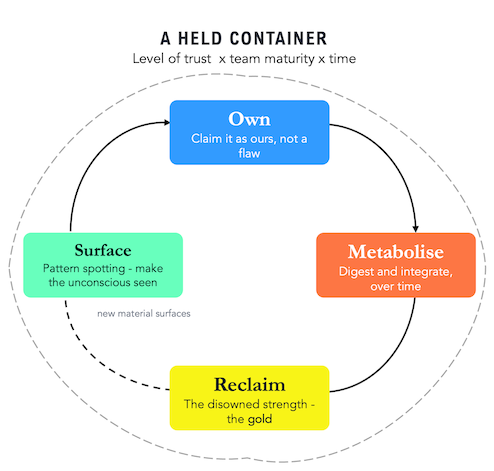
This work takes time, a long-term, trusting container between team and practitioner, and a collective desire for betterment. It’s a virtuous loop around four stages:
Surfacing. Getting the unspoken thing said out loud, which is harder and more unsettling than it sounds, because a shadow is precisely what a group has agreed not to look at. A powerful way into this is ‘triggers’ work: noticing the things which have created disproportionate reactions in individuals and in the team, since the thing that hooks us is usually pointing at something we’ve disowned.
Owning. The team taking responsibility for its part instead of locating the problem in one difficult person, or the sector, or the past. This is about spotting our own projections: the trait we can’t stand in a colleague is often the one we won’t own in ourselves, so the work is each person finding their share of it rather than electing a villain. For example: an overly optimistic team that sees one person as “the negative one who picks holes and slows things down”. Owning it turns the mirror on them to see that others have outsourced their own doubt to her, so she carries all the scepticism for the group while they get to stay positive. She isn’t the problem; she’s holding a disowned part for the whole team. The work is each of them reclaiming their own reservations, at which point she stops having to be the lone dissenter and the doubt gets shared out honestly.
Metabolising. The slower process where the material gets digested and felt and allowed to change something (rather than just theoretically understood and left behind). With the example above, the first few times they try to sit in a meeting where the scepticism is shared out and nobody’s rescuing the mood, it can be uncomfortable because the pull is to smooth it over and move on. Staying with that discomfort, again and again, until disagreement starts feeling healthy and normal, is the slow part.
Reclaiming. Taking back the disowned capacity, the gold, and putting it to work. e.g. the doubt the team used to avoid becomes the way they pressure-test the decisions that matter, so the scepticism that was a problem when one person carried it is a resource now everyone shares it.
And some shadows are workable while others are not. The unworkable ones tend to be structural, built into the sector (e.g. NHS chronic understaffing), the ownership model (e.g. a PE fund’s five-year exit clock), or the economics, and no amount of teamwork shifts them. The skill is telling which is which and giving the team the safety, space and agency to identify, own and explore them together.
Liberating teams
The shadow and culture a top team casts comes down to one of two things - either it’s the residue of what the team won’t face, leaking out into everyone below, or it’s the healthy and more integrated (and individuated) expression of what the team has been willing to work through.
The prize for facing it isn’t comfort; it’s a kind of liberation. A team stops being run by what it can’t or won’t see and gets to draw on the whole of itself (the numbers and the intuition, the commitment to the cause and the challenge of it) rather than the half it finds acceptable. And the organisation underneath stops living out what its leaders can’t face and gets to be the whole of what it is too.
So, my investment banker friend was right that a lot of culture work is bollocks. What he missed is that culture was actually the most real thing in the room, but also the least visible because his sector had trained him not to see or use it. That reflex (dismissing whatever you can’t measure) is just one more shadow and a common one. Most of us are fluent in everything except our own shadow. Facing it is the work, in ourselves and in the teams we lead. It’s slow and sometimes uncomfortable work, but it’s the difference between a culture that happens to a team and one the team has chosen – clear eyed and open about all of its beautiful parts.